Have you ever asked a friend to do something, but you gave them a confusing instruction? They probably got it wrong. AI models work the same way. If you want an AI model to do a great job, you need to give it clear, smart instructions. That’s what a “prompt” is: the instruction you type in.
This guide explains the best practices for training AI models with prompts, in plain, simple language anyone can follow.
Table of Contents
What Does “Training AI with Prompts” Really Mean?
There are two different things people mix up:
- Training usually means changing the actual “brain” of the AI model with new data, math, and lots of computer power.
- Prompting means guiding an AI model that is already trained, using smart instructions without changing its brain at all.
Think of it like coaching a soccer player versus rebuilding their muscles. A coach (prompting) can’t change a player’s body, but great coaching can still turn an average player into a star performer on the field. That’s exactly what a well-written prompt does for an AI model.
Why Good Prompts Matter So Much
A small change in wording can produce a huge change in the AI’s answer. Here’s a simple comparison:
| Weak Prompt | Strong Prompt |
|---|---|
| “Write about dogs.” | “Write a 100-word paragraph for 8-year-olds explaining why dogs need daily walks. Use simple words and one fun fact.” |
| “Fix this.” | “Rewrite this paragraph to fix grammar mistakes, keep the same meaning, and use a friendly tone.” |
| “Explain math.” | “Explain how to add fractions, step by step, using a pizza example a 10-year-old would understand.” |
Notice the pattern? Strong prompts are specific. They explain who it’s for, what format to use, and how to sound.
A Quick Look at the Numbers
Prompting isn’t just a nice-to-have skill anymore, it has quickly become one of the most useful ways to get value out of AI. A few figures worth knowing:
| Fact | Why It Matters |
|---|---|
| Even 1-2 examples in a prompt can noticeably change output quality | Shows why “few-shot prompting” is such a popular, low-effort technique |
| Chain-of-thought style prompting improves accuracy most on multi-step reasoning tasks (like math word problems) | Explains why “think step by step” has become a common instruction |
| Fine-tuning a small model can sometimes be done in minutes to hours using modern techniques | Shows that even “advanced” training options are more accessible than they used to be |
| RLHF (reinforcement learning from human feedback) is a core part of how many modern chat AI models are shaped | Shows that giving feedback isn’t just a user habit it mirrors real industry practice |
These numbers help explain why use ai search monitoring and why so many companies now treat “prompt writing” as a real skill worth training employees in, not just a fun hobby.

7 Beneficial Practices for Training AI Models with Prompts
These practices are used by people who work with AI every day and they work whether you’re using a chatbot for homework help or building a business tool.
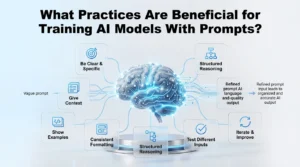
- Be specific and give context. Instead of “write a story,” say “write a 200-word adventure story about a lost puppy, for a children’s book.” The more details you give, the less guessing the AI has to do.
- Show examples (this is called few-shot prompting). Give the AI one or two examples of what you want before asking it to continue. For example, show it two example sentences, then ask it to write a third one in the same style. Research on large language models has shown that giving even a handful of examples can noticeably improve how well a model follows a pattern.
- Break big tasks into steps (chain-of-thought prompting). If you ask an AI to solve a tricky problem, ask it to “think step by step” or show its reasoning. This helps the model catch its own mistakes, especially for math or logic problems.
- Give the AI a role or persona. Saying “You are a friendly science teacher” or “You are a patient math tutor” changes how the AI responds; it adjusts its tone and level of detail to match that role.
- Tell it exactly what a good answer looks like. Specify format: “Answer in three bullet points,” or “Keep it under 100 words.” Clear instructions reduce back-and-forth.
- Test, review, and improve your prompts. Nobody writes a perfect prompt on the first try. Try it, check the answer, then tweak your wording. This loop is the single most important habit of anyone good at working with AI.
- Give the AI feedback on its answers. When you tell an AI “that was too long” or “that was perfect,” you’re doing a mini version of what experts call reinforcement learning from human feedback (RLHF) , a real technique companies use where people rate AI answers so the model learns what “good” looks like.

A Real-World Example, Step by Step
Let’s see these practices working together. Imagine you want an AI model to help write short product descriptions for an online toy store.
- Weak first attempt: “Write a product description for a toy.”
- Adding context (practice #1): “Write a 50-word product description for a wooden building block set aimed at parents shopping for kids aged 4-8.”
- Adding an example (practice #2): “Here’s an example of our brand’s tone: ‘Spark your child’s imagination with colorful, chunky blocks built to survive years of play.’ Now write a similar description for our new dinosaur-shaped block set.”
- Reviewing and giving feedback (practices #6-7): If the first draft feels too long, you’d reply: “Great start, but shorten it to 40 words and mention it’s dishwasher-safe.”
Notice how each step builds on the last one. That’s the real skill not writing one perfect prompt, but running a short back-and-forth loop until the result is right.
Common Mistakes to Avoid
- Being too vague. “Make it better” doesn’t tell the AI how to make it better.
- Asking for too much at once. Break large requests into smaller steps.
- Forgetting to check the answer. AI models can sound confident and still be wrong, always double-checking facts.
- Never giving feedback. If you don’t say what worked or didn’t, you can’t improve your next prompt.
- Ignoring the audience. Always mention who the content is for a young reader, a beginner, an expert so the tone matches.
Prompting vs. Fine-Tuning: Which Should You Use?
Sometimes prompting isn’t enough, and people ask whether they should “fine-tune” a model instead. Fine-tuning means retraining part of the model on your own examples so it permanently learns a new skill or style.
| Prompting | Fine-Tuning | |
|---|---|---|
| Changes the model’s brain? | No | Yes |
| Speed to try | Instant | Hours to days |
| Cost | Usually free or very low | Can range from a few dollars to thousands, depending on model size |
| Best for | Quick tasks, one-off requests, experimenting | Repeated, specialized tasks like a customer-support bot for one industry |
A good rule of thumb: start with prompting first. Only move to fine-tuning if prompting truly can’t get the results you need most people never need to go further than a well-written prompt.

A Simple Practice Checklist You Can Save
Next time you sit down to write a prompt, run through this short checklist:
- Have I said who the answer is for?
- Have I said what format I want (list, paragraph, table)?
- Have I given at least one example, if the task is unusual?
- Have I asked the AI to explain its thinking for anything tricky, like math or logic?
- Have I planned to review the answer, not just accept it right away?
- Have I thought about what feedback I’ll give if it’s not quite right?
Keeping this list nearby turns prompting from guesswork into a repeatable skill the same way a recipe turns cooking from guessing into a reliable process.
For more information visit our blog page.
FAQs About What Practices Are Beneficial For Training Ai Models With Prompts?
Do I need to know coding to write good prompts?
No. Prompting is about clear writing, not programming. Anyone who can write a clear instruction can learn it.
How many examples should I include in a prompt?
Even one or two clear examples (few-shot prompting) can noticeably improve results for many tasks you don't need dozens of.
Can bad prompts "break" an AI model?
No, a prompt can't damage the model itself. It can only lead to a lower-quality answer, which you can always fix by rewriting your instructions.