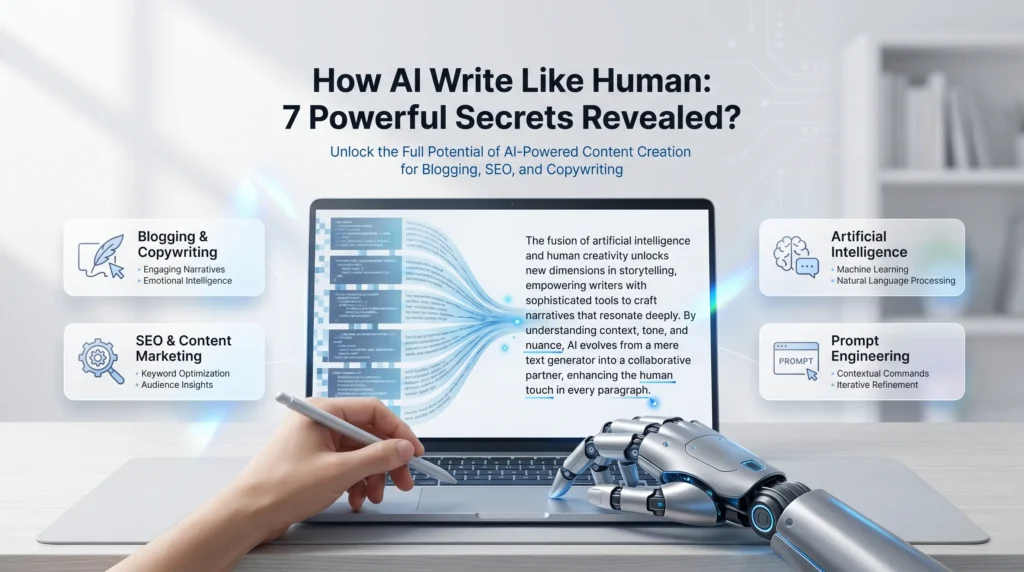
The landscape of content creation has been revolutionized by AI. Whether it’s blog posts, emails, social media posts, marketing copy, or anything else, AI can produce thousands of words in mere seconds. However, despite the incredible abilities AI has to offer, there’s certainly a problem users have with content created or edited by AI: it often sounds like a robot.
Every day people probably notice it more than they notice me. The grammar is correct, structure is well-organized, and information is accurate but something is missing. Tailor written content to have a persona. It is very general and repetitive, and is not even a real human way of communicating.
That’s why surfers of the internet, content creators, bloggers, business owners and marketers look for solutions to these questions: how AI write like human, how to get AI to write like a human, and how to prompt AI to write like a human?
Fortunately, AI programs today can create really authentic content. Most of the time, the difference between robotic AI writing and human-like AI writing revolves around how the text is formatted, what prompt is being used, and the editing process.
This guide covers the reasons behind unnatural-sounding AI writing and how to direct AI to generate more naturally written content and the exact formula you can use to produce content that is genuine, engaging, and gives a conversational tone.
Table of Contents
Understanding What Human Like Writing Really Means
Understanding human writing patterns is crucial before comprehending how to make AI write like a human in the first place.
Some people think that human writing is just about correct grammar and spelling. In fact, those factors represent just a fraction of what authenticity means with regards to content.
One thing about human writing is that good writing is usually substandard. Sentences are varied naturally. They ask questions, express opinions, recount stories and sometimes deviate from accepted word order to express emphasis. Human writers add personality, emotion and unique perspectives to the content.
AI, however, is more about predictable outcomes. Results in content that is often well-structured, patterned and familiar based on how it has learned language from the large amount of training data.
Therefore, AI content can be technically correct but not feel like it’s human-generated with the personal style, tone, and “human flow” readers expect.
Users on this topic typically seek methods to address this disconnect between humans and AI. They are looking for a sense of authenticity, personal connection, and”talkativeness” in content generated by AI, as well as trustworthiness.
Why AI Writing Often Sounds Robotic
The worst thing people do is think it has failed the AI instead of the system.
If it were the AI’s fault, the answer would be straightforward. In most scenarios, the issue is not the AI. The trouble with the question is the instructions.
Lack of Context Creates Generic Content
Would you invite a stranger to write an article unless it’s for a sum of a few hundred dollars? Would you ask a stranger to write an article about nothing?
The writer would need to make estimates regarding the audience, tone, purpose, and knowledge level of an audience.
It’s the same challenge that AI has.
If the instructions given to the AI are very general, the AI may produce content that is generic and broad rather than specific.AI might create general, broad content since it cannot tell what direction you are going in if you give it vague instructions.
For instance, one of the suggestions might be:
Create a blog post on SEO.
will tend to yield generic info.
To achieve greater detail or scope, you could clarify:
Write a blog post that would be helpful to someone who is brand new to digital marketing who owns their own small business. Keep it casual, in basic terms, and with real-life examples.
The AI gets a lot more direction with just some hints from gives.
It was decidedly more human right away thanks to its intent and target audience.
AI Prefers Predictable Writing Patterns
Another major reason why AI content takes a robotic voice is that they tend to have a repetitive structure.
Here are some common expressions that are often found in AI-generated articles:
“Furthermore…”
“Moreover…”
“In addition…”
“Therefore…”
These transitions are not necessarily incorrect as long as they are overused they make it feel as though the writing is formulaic.
As is natural, human writers have different ways of tying together ideas. These occasionally make some transitions. Sometimes they don’t. In places they pose a question or a brief statement to begin a new idea.
This change makes it easier on the reader.
AI Avoids Strong Opinions
There are many times when writers have a point of view when they write for humans.
They concur and dissent with some responses. They draw conclusions from past realities and tell why they may believe something.
AI tends to remain neutral when it comes to strong opinions, unless programmed to do otherwise.
This also contributes to its content being perceived as more neutral and less engaging.
Viewpoints resonate with readers because readers recognize about the expert or the personality in the viewpoint.
AI Cannot Draw from Personal Experience
A human author can write:
“When I started with my first site, I was busy about traffic and not conversions”
It can’t make such claims in the name of AI, as there isn’t any real-life experience with AI.
Rather, it will use exaggerated illustrations.
This doesn’t indicate that AI content can’t be human. Only drive it towards making realistic scenarios and understandable examples for readers.

How AI Write Like Human: The Proven Framework
There’s no secret trick or special software to make AI content that’s human-like. It’s a process.
The best writers employ a logical framework that continually enhances AI performance.
Step 1: Assign a Specific Role
One of the most straightforward strategies to enhance AI writing involves specifying the persona of the AI.
Instead of instructing AI to create an article, tell it who you want this article to be written by.
For example:
Think like an experienced content marketer with a niche of writing educational blog posts for small businesses.
This easy code attaches a point of view to the ai.
It doesn’t create generic content – it starts writing from a specific role.
Step 2: Clearly Define the Audience
All the time, human authors are considering their readers.
They pay attention to the audience, to what they have to experience and to which information they need.
The same advice should be offered to the AI.
Instead of saying:
Write an essay about email marketing.
Try:
For small business owners who want to increase customer retention via e-mail marketing.
The more specific it is, the more of a niche can the AI produce.
Step 3: Define the Desired Tone
Tone is a major component of humanizing content.
To see that, you must be reading the product, which unfortunately, was largely robotic due to the lack of any tone being set.
Results can be significantly better if the style desired is clearly indicated.
For example:
Tone, register, and style: Write informally, in a friendly, approachable style.
Or:
Use a professional, intelligible and straightforward writing style that is appropriate for novices.
The more understanding AI has of the emotional texture of the writing, the more natural the output will be.
Step 4: Add Human Writing Instructions
This is the step in which the transformation truly starts.
AI can be taught to replicate many of the qualities of human writing that makes it captivating.
If you want, for instance, instruct the AI to change the length of sentences, use contractions as if they were common in everyday talk, avoid over-formal or business-cased language, pose real-world examples, and consume the writing style of a direct conversation with one reader.
By incorporating these instructions, you can foster more natural language patterns and eliminate the robotic-like tone that can sometimes be present in AI-generated content.
Step 5: Request Practical Examples
An example is one of the most potent ways to keep a piece of content human.
Readers relate to situations they can identify with.
When requesting a concept, don’t just give the explanation, ask AI to provide examples or scenarios that are open, imaginary, or real.
This fosters a deeper sense of involvement and understanding.
How to Prompt AI to Write Like a Human
One of the most useful skills is the ability to prompt developed in the era of modern content.
Your prompt can make a huge difference in the quality of output.
A strong prompt is like a super long creative brief. It conveys to AI what content to put, how to write it, and who it is meant for.
A Human Like Writing Prompt Template
A great questioning cue could be as follows:
Think like an expert writer, write for novice readers unfamiliar with this topic, use conversational style and be engaging, avoid robot style or business diction, use examples and real world knowledge that the reader will find familiar, write as if speaking directly with the reader, emphasize clarity, authenticity and readability.
Such a prompt will give enough context to AI to be able to provide much more natural writing.
Using Writing Samples to Improve Results
One more strategy would be giving examples of writing that you are attracted to.
You can input a bit of text and have AI match its tone, style, and structure.
Before they have a clear reference point, AI does an impressive job – this is why this approach is very effective.
The more similar your model is to your desired result, the closer your final result will come to your desired result.
How to Get AI to Write Like a Human Consistently
It is not random artistry.It’s not a blind shot or some fluke.
It’s about the need to be repeatable.
The best content makers are able to use AI as a partner–not a replacement for their own judgment.
They add detailed prompts, take a careful look at the results and make adjustments to the content for publication.
Making it consistent is dependent on repeating the process each time.
Have a clear goal.
Define the audience.
Specify the tone.
Provide examples.
Review the draft.
Fine tune the final version.
Once you’ve integrated these into your process, you’re on your way to better AI generated content.
How to Tell AI to Write Like a Human
The simplicity of instructions can often yield surprisingly great results.
The main thing is to be clear in communicating expectations.
AI: You may say, for instance,
“Write as if you were talking to a close friend.”
Or:
Keep writing at a simple or non-academic level of language.
Of course, you can also get AI to prioritize storytelling, insights, or speaking it aloud naturally.
The closer your directions, the closer your result.
One common pitfall many users face is just thinking that AI will do their preferred style automatically.
In practice it is quite common to find that explicit teaching brings about greater success.

How to Make AI Write Like a Human Through Editing
The best prompts can’t do the job of human editing.
The best stuff on the Web doesn’t just appear out of nowhere: it’s usually created and posted after someone has looked it over.
That’s where good content truly becomes great with the power of editing by AI.
Read the Content Out Loud
The first and easiest editing techniques is reading it out loud.
Avoid awkward phrasing it becomes apparent when uttering out loud.
When a sentence doesn’t sound natural, it will not sound natural when read by a reader.
Replace Generic Language
AI’s grammar tends to be colloquial.
It is a no-brainer that the elimination of these expressions will instantaneously make the phone call seem more authentic.
Avoid making broad statements, and see where you can be more specific for improved clarity.
Specifics make content more convincing and attractive.
Introduce Personal Insights
While using AI to create a first draft, you can enhance the content by incorporating your own perspectives and experiences.
Personal insights are challenging to emulate as it’s an actual world view.
These additions not only make your posts more engaging, but also add a touch of uniqueness to your articles when compared to your other competitors.
Create More Variety
The rate and flow of human writing is variable.
A few paragraphs are brief. Others are longer.
Stories used to introduce some ideas. Others are introduced in which.
Incorporating diversity can engage readers and eliminate some of the patterns AI-generated text may feature.
Here are some typical issues that can lead to content that sounds like AI.
Unfortunately, many content creators are unaware of these slips that expose AI involvement.
Common Mistakes That Make AI Content Obvious
One of the others is the lack of identifying the target audience.
Certain writers write content straight out of the AI answer box and it’s frequently repetitive and has not that many good examples.
Some people prioritize keywords to the extent that they make it challenging to read through the content.
Always do it first for the reader and do it right.
The authentic nature of content isn’t confined to its engagement with people’s cognitive or emotional needs, but extends itself when it’s useful to the resolution of problems.
Can AI Truly Write Like a Human?
This is one of the most common queries in content creation today.
The answer is: yes and no.
Yes, you can definitely create content that can sound very human-like with AI. Many readers will not easily detect if a text was created by AI or through a more conventional writing process, depending on the AI and editing.
But, there is an advantage AI is missing.
Has no practical experience to add.
It is not a true reflection of childhood experiences, of personal experiences or of lessons from real-life experiences.
They are experiences which are rarely to be duplicated among other human beings.
The best way to approach this is not at the “AI vs. Human” level.
It’s combining them.
AI can streamline research, provide ideas, structure data and produce rough drafts.
Humans can give judgment, creativity, expertise and authenticity.
As a team they make a compelling content creation duo.
Conclusion
The whole idea of AI writing like a human is about comprehending the nature of good writing rather than the ideal tool.
A personable, well-told, and clear message is produced by human-like context and clarity.
Having a clear audience to address, choosing the appropriate tone, giving clear instructions and taking your time to craft output carefully is enough to make AI-generated content much more engaging and natural.
It’s not about replacing human writers in the future of content creation. This is actually about enabling them.
The most successful writers are those that incorporate AI into their workflow to aid in their creative process but ensure they add in their own knowledge, experience, and point of view.
By adhering to the structure provided in this guide, you can produce more engaging, reader-friendly AI-generated content, resulting in improved quality and stronger results.
FAQs
How do I get AI to write like a human?
The key to inducing human-like writing from AI is to give a clear, specific instruction rather than generic ones. First of all, identify the audience, tone and purpose of the content. Make sure you instruct the AI to speaks in conversation, change sentence structures, provide relatable examples, and steer clear of robotic phrases. The strongest results are typically achieved by a combination of powerful prompts and a human edit to add personality, clarity, and authenticity.
How do I prompt AI to write like a human?
The prompt should specify exactly how the content should sound if it is to be correctly understood. For example:
Pronounce your voice as one of the experienced bloggers talking directly to the novices. Write it in the conversational tone, using natural transitions, varying the sentences length and structure, and employing practical examples. Avoid corporate jargon, AI-sounding phrases, look for clarity and readability.
The more context and direction you include, the more human-like it will sound.
How can I make AI writing less robotic?
The most straightforward path to making AI-driven writer human-like is to eliminate idiomatic expression phrases, streamline lingo and use real-life examples. You can also have the AI use contraction, pose occasional questions, and write in the way you want it to sound like you’re speaking with the reader. Once content has been created, check the content by hand to make sure it makes sense.
What is the best prompt to make AI write like a human?
One of the best promptings is:
Write like a seasoned author; write for a specific target audience; think in conversational and engaging sentences; use natural language; be full of practical examples and use generic phrases from the AI, and avoid!
This prompt is great for blog posts, articles, emails and marketing material because it allows for normal writing patterns.
How do I tell AI to write like a human?
Give directions like: “Write like a human,” to the AI to write like a human.
1 – Use a conversational style to write.
2 – Use everyday language.
3 – Do not be excessively polite or formal.
4 – Include relatable examples.
5 – Discuss topic as if you were talking to a friend.
6 – Use a variety of sentence and paragraphs structures and lengths.
These directions guide AI to produce more authentic writing, away from the trend of using generic language.
Can ChatGPT write like a human?
With clear instructions and context, yes, ChatGPT can generate very human-like content.When instructed properly with context, yes, ChatGPT can create very human-like content. But the prompt is a significant determinant of the quality of the work produced. With the help of ChatGPT, it will be possible to generate text using the conversational style of writing, with its conversational personality, adding personal experiences, unique or expert opinions will lead to that content becoming even more natural and engaging for its users.