What Practices Are Beneficial for Training AI Models With Prompts?
Discover the best practices for training AI models with prompts, clear instructions, examples, testing, and iteration for more accurate AI results.
On this page
- Table of Contents
- What Does Training AI With Prompts Really Mean?
- Why Prompt Quality Actually Matters
- 7 Best Practices for Training AI Models With Prompts
- Prompting Techniques at a Glance
- Prompting vs In-Context Learning vs Fine-Tuning
- How to Test and Evaluate an AI Prompt
- Common Prompting Mistakes to Avoid
- AI Prompt Quality Checklist
- Conclusion
- FAQs About What Practices Are Beneficial For Training AI Models With Prompts?
Have you ever asked an AI a question and gotten a strange or off-target answer? Most of the time, that’s not the AI being unhelpful. It’s the prompt not giving it enough to work with.
The words you type into an AI are called a prompt. Think of a prompt as instructions for an incredibly well-read assistant who still needs you to explain exactly what you want.
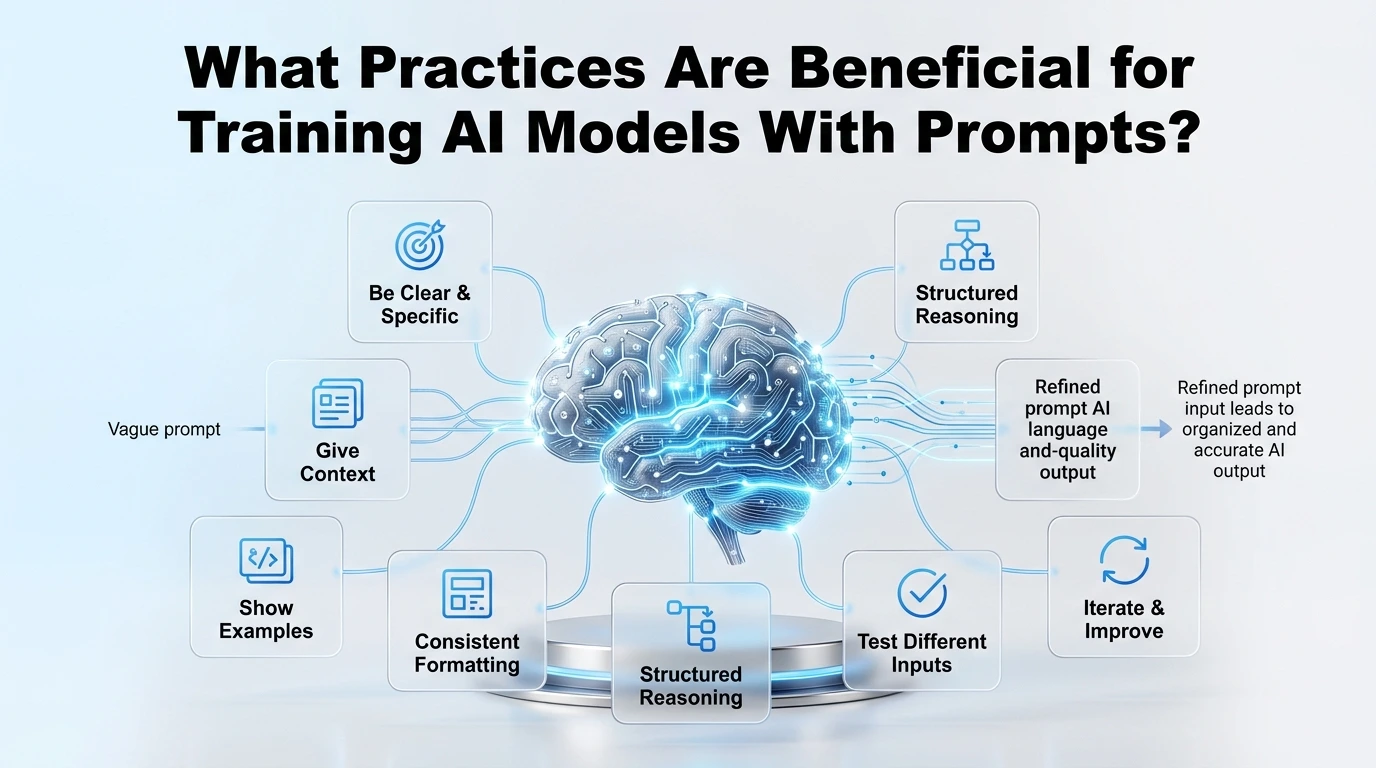
The short answer: the practices that work best are being clear and specific, giving context, showing examples, keeping your formatting consistent, asking for step by step reasoning on hard problems, testing your prompts on more than one input, and revising based on what goes wrong. None of these are tricks. They’re closer to good communication habits.
One thing worth clearing up early: for most people, “training AI with prompts” doesn’t mean literally retraining the model. That distinction matters, and it changes how you should think about prompting.
Table of Contents
What Does Training AI With Prompts Really Mean?
Picture an AI model as someone who has read an enormous amount of information but has never met you. It doesn’t know your goal, your audience, or your preferred style until you tell it. There are a few different ways people guide an AI, and they work differently from each other.
Prompting means typing an instruction or question. This shapes the AI’s response for that one interaction only. It doesn’t change anything inside the model.
In context learning means including examples directly in the prompt, so the model follows the pattern within that same conversation. It still doesn’t change the model itself.
Fine tuning means feeding a model many example prompts and responses through an actual training process. This updates the model’s internal settings, so the behavior carries over into future sessions without needing those examples again.
Pretraining, or full training, is the original large scale training process that created the base model in the first place. This is done by AI companies using huge amounts of data and computing power. It is not something an everyday user does by typing a prompt.
So when people talk about “training AI with prompts,” they usually mean prompting and in context learning. These techniques shape the output you get right now. If you want a change that sticks around without repeating yourself every time, that’s what fine tuning is for.
Why Prompt Quality Actually Matters
Prompt wording isn’t just a style choice. It changes the quality of the answer you get.
Google researchers introduced a technique called chain of thought prompting in 2022. It simply means asking a model to reason through a problem before giving a final answer. In one published study, a large model’s accuracy on a set of math word problems rose from about 18 percent with a standard prompt to nearly 57 percent when it was asked to reason step by step. That’s a real result from a real paper, and it shows how much wording can matter. Results like this vary by model and task, so treat it as a useful example rather than something every prompt will repeat.
OpenAI’s original research on GPT-3 also found that giving a model a few examples in the prompt generally produced better results than giving it none, especially on harder tasks. Examples genuinely help a model understand what you want.
The takeaway isn’t “write longer prompts.” It’s that specific, well structured prompts consistently outperform vague ones.
7 Best Practices for Training AI Models With Prompts
1. Be Clear and Specific
Vague prompts produce vague answers.
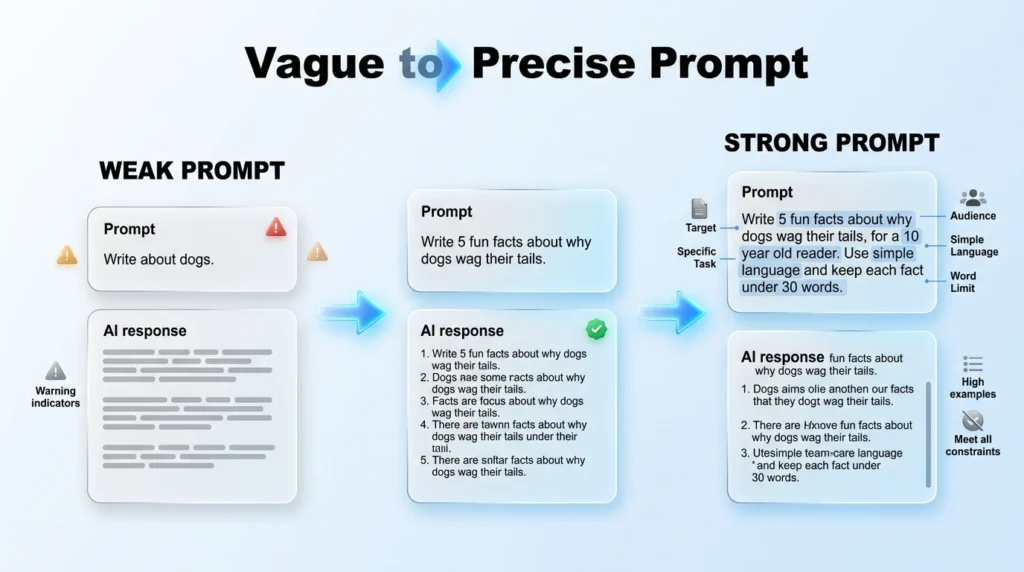
- Weak prompt: “Write about dogs.”
- Better prompt: “Write 5 fun facts about why dogs wag their tails.”
- Best prompt: “Write 5 fun facts about why dogs wag their tails, for a 10 year old reader. Use simple language and keep each fact under 30 words.”
The final version works better because it removes guesswork. The audience, the length, and the tone are all defined, so there’s only one clear target instead of many possible interpretations.
2. Give the AI Enough Context
Context tells the model who the answer is for and why.
Without context: “Explain photosynthesis.”
With context: “Explain photosynthesis to a 6th grade science class using a simple analogy.”
Same question, but a much more useful answer.
3. Use Examples With Few-Shot Prompting
If you want a specific style or format, show it instead of describing it.
“Here are two product descriptions in our brand voice. Write a third one for our new water bottle in the same style.”
The model matches your examples instead of guessing at an abstract description of your style.
4. Keep Instructions and Formatting Consistent
If you always ask for the same structure, such as three bullet points under 20 words each, the model has a stable target to hit every time. It also makes it much easier for you to judge whether an answer is actually good.
5. Use Structured Reasoning Prompts for Complex Tasks
For multi step problems like math, logic, or planning, asking the model to reason before answering can help.
Direct prompt: “What’s 20 percent off a $145 jacket after an additional $10 discount?”
Structured reasoning prompt: “Solve this step by step, showing your work: What’s 20 percent off a $145 jacket after an additional $10 discount?”
Seeing the steps also makes it easier for you to catch a mistake, instead of only seeing a final number with no way to check it.
6. Test Prompts With Different Inputs
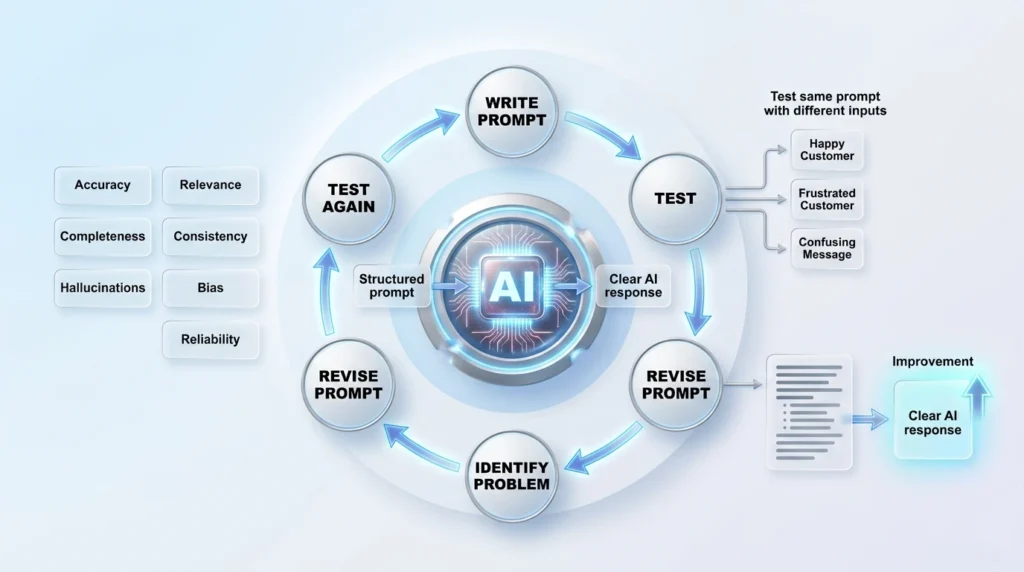
Don’t judge a prompt from a single response. Run it against a few different inputs and see if it holds up.
For example, test a customer support reply prompt on a happy customer, a frustrated customer, and a confusing message, not just one friendly sample.
7. Iterate and Improve Your Prompts
If an answer misses the mark, revise the prompt instead of giving up. Add a missing detail, remove a confusing phrase, or add an example. Small wording changes often lead to noticeably better results.
Prompting Techniques at a Glance
| Technique | What It Means | Simple Example |
|---|---|---|
| Zero shot | Asking with no examples | “Summarize this article in 3 bullet points.” |
| Few shot | Giving a couple of examples first | “Here are 2 sample headlines. Write a third in the same style.” |
| Structured reasoning | Asking the model to reason step by step | “Solve this problem, showing your work at each step.” |
| Role based | Assigning the AI a persona | “You are a patient 5th grade science teacher. Explain…” |
| Instruction based | Giving a direct, explicit command | “Rewrite this paragraph in under 50 words, formal tone.” |
Prompting vs In-Context Learning vs Fine-Tuning
| Method | How It Works | Best For | Changes The Model? |
|---|---|---|---|
| Prompting | Typing instructions for one interaction | Quick, everyday tasks | No |
| In context learning | Adding examples inside the prompt | Guiding style within one session | No |
| Fine tuning | Additional training on many example pairs | Repeating one specialized task at scale | Yes |
| Full pretraining | Building a model from scratch on massive data | Creating a new base model | Yes |
Most everyday users only ever need prompting and in context learning. Both are free, instant, and require no coding. Fine tuning and pretraining are separate processes usually handled by developers or AI companies.
How to Test and Evaluate an AI Prompt
A prompt working once isn’t proof that it’s good. Test it against several inputs and check for these things.
- Accuracy: is the information actually correct?
- Relevance: does it address what was actually asked?
- Completeness: is anything important missing?
- Consistency: does the same prompt produce similar quality across different runs?
- Formatting: does it follow the structure you asked for?
- Hallucinations: did it invent facts, sources, or details?
- Bias: does it lean unfairly toward a group, opinion, or stereotype?
- Reliability: would you trust this output without double checking it?
A reliable prompt holds up across multiple test cases, not just one good response.
Common Prompting Mistakes to Avoid
- Vague requests like “make it better,” which give the model nothing concrete to act on.
- Cramming several unrelated requests into one confusing sentence.
- Judging a prompt from a single response instead of testing it.
- Ignoring odd, biased, or invented answers instead of rewording the prompt.
- Skipping examples on unusual or highly specific tasks.
- Assuming a good result today will repeat automatically, without remembering that prompting doesn’t change the model itself.
AI Prompt Quality Checklist
- Clear objective stated
- Relevant context included
- Specific instructions for audience, length, and tone
- Examples provided where style or format matters
- Desired output format specified
- Constraints defined, such as word count or restrictions
- Tested against multiple inputs
- Output fact checked for accuracy
- Revised based on results
Conclusion
So, what practices are beneficial for training AI models with prompts? Be specific, provide real context, show examples instead of only describing what you want, keep your formatting consistent, use structured reasoning for multi-step problems, test across several inputs rather than one, and revise based on what actually goes wrong.
Remember the distinction that matters most. Prompting shapes a single response. Fine tuning is what actually changes the model. Apply the practices above, and you’ll get noticeably better, more consistent results from any AI tool you use, without needing to retrain anything.
Learn more about AI usage through our guides and blogs.
FAQs About What Practices Are Beneficial For Training AI Models With Prompts?
What practices are beneficial for training AI models with prompts?
Being specific, giving context, showing examples, keeping formatting consistent, using structured reasoning for complex tasks, testing across multiple inputs, and iterating based on results.
What makes a good AI prompt?
A good prompt states the goal clearly, gives relevant context, specifies the desired format, and includes examples when style or structure matters.
Does prompt quality affect AI accuracy?
Yes. Published research on techniques like few shot prompting and structured reasoning prompts shows that prompt wording can meaningfully change output quality.
What is few-shot prompting?
Few shot prompting means including a small number of examples directly in your prompt so the model can follow that pattern. Zero shot prompting gives no examples at all.
What is the difference between prompting and fine-tuning?
Prompting guides a model’s output for a single interaction without changing the model itself. Fine tuning is a training process that updates the model’s internal settings, so the change carries over into future use.
How can I improve an AI prompt?
Test it against several different inputs, note where it fails, such as wrong facts, wrong tone, or missing details, and revise the wording to fix that specific gap. Then test again.
Can better prompts reduce AI hallucinations?
They can help. Clear, specific, and neutral prompts reduce the chances of an AI guessing or inventing details, though they can’t eliminate hallucinations completely. Always verify important facts.
AI tools change often. We check our guides and update them when steps change. Spotted something out of date? Tell us and we’ll fix it.