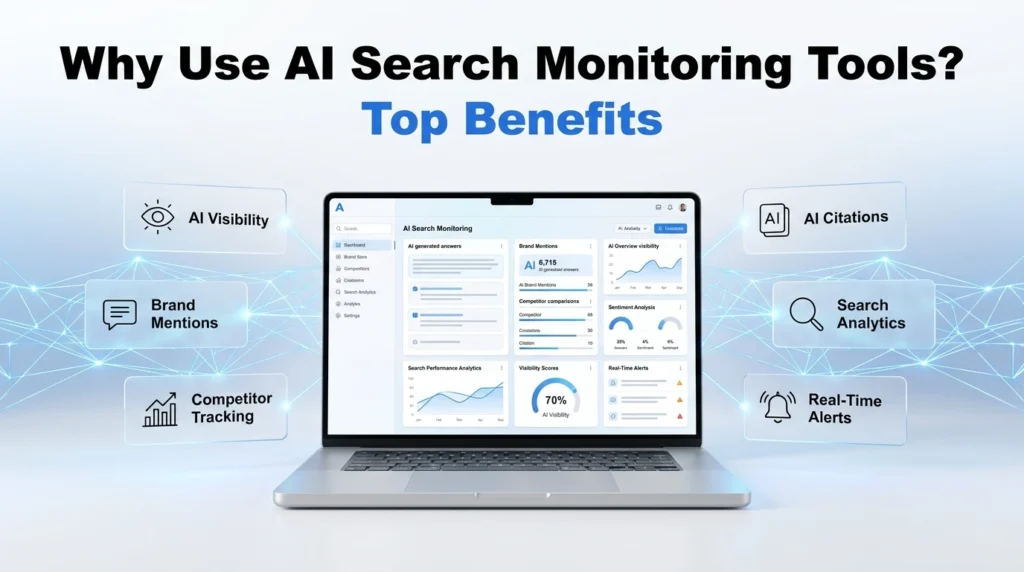
Short answer: You should use AI search monitoring tools because normal rank trackers can’t see whether your brand shows up inside AI-generated answers like Google’s AI Overviews, ChatGPT, or Perplexity and that’s quickly becoming where a huge number of searches actually happen. Without monitoring, you could be losing visibility and never even know it.
Table of Contents
What Do AI Search Monitoring Tools Actually Do?
AI search monitoring tools track how often and how accurately your brand, website, or products get mentioned inside AI-generated answers. Instead of just checking “am I on page 1 of Google,” they check things like:
- Does the AI mention my brand at all?
- Is what it says about me actually correct?
- Which competitors are showing up instead of me?
- Which of my pages are being used as a source?
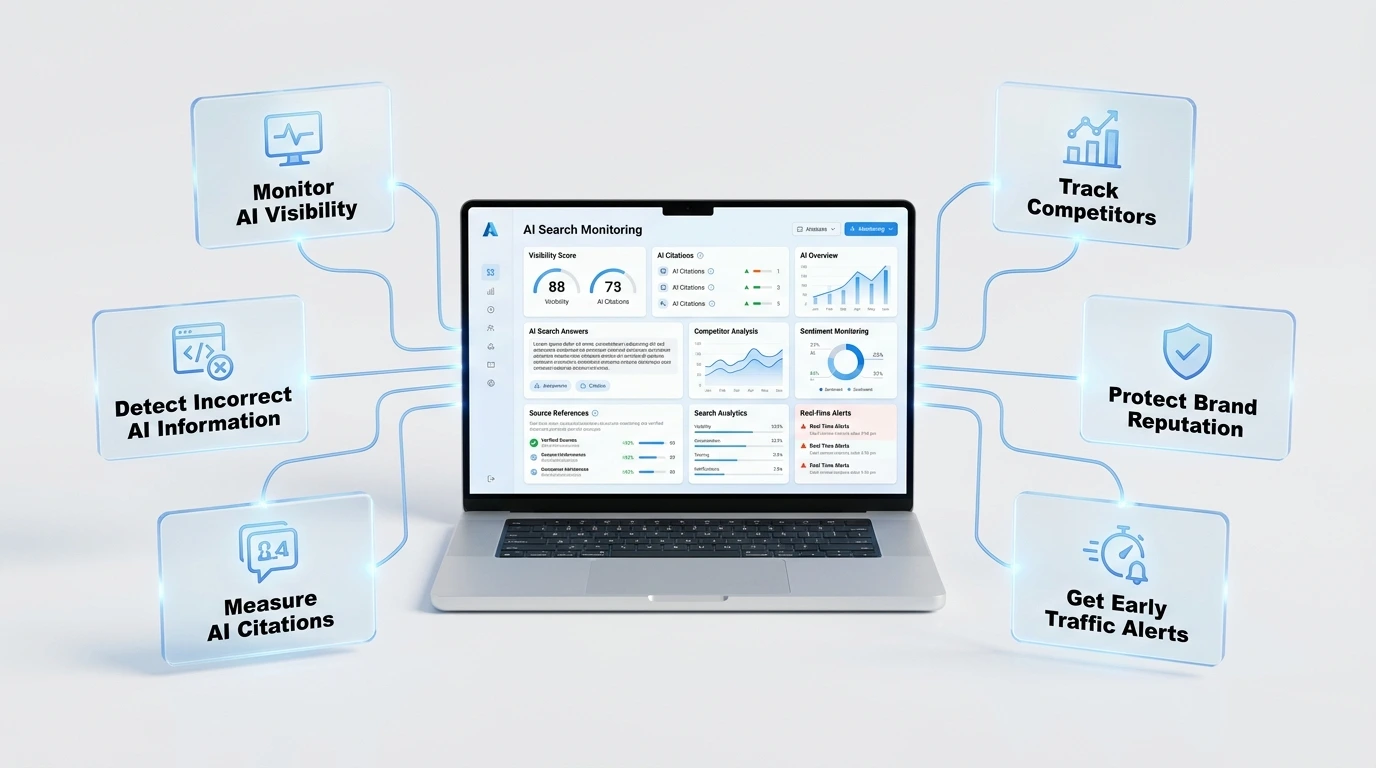
6 Reasons to Use AI Search Monitoring Tools
1. Normal Rank Trackers Are Blind to AI Overviews
A classic SEO tool can tell you that you rank #1 on Google. But it usually can’t tell you whether an AI Overview box appeared above your listing and whether people even scrolled down far enough to click your link.
2. AI Overviews Can Reduce Clicks Even When You Rank #1
Research from Ahrefs found that a page ranking in the #1 spot can lose as much as 34.5% of its expected clicks when an AI Overview appears above it. That means great rankings don’t always translate into the traffic they used to.
3. Most AI Overview Questions Are Informational A Huge Opportunity Zone
About 88% of the queries that trigger an AI Overview are informational, meaning people are trying to learn something, not necessarily buy right away. That’s a massive audience of curious readers, and monitoring shows you whether you’re reaching them.

4. You Can Catch Inaccurate AI Claims About Your Brand
AI systems sometimes get facts wrong; this is called a “hallucination.” Monitoring tools can flag when an AI answer says something incorrect about your prices, products, or policies, so you can correct it before it spreads.
5. You Can Benchmark Against Competitors Across Multiple AI Engines
Different AI platforms (Google AI Overviews, ChatGPT, Perplexity, Gemini, Copilot) can favor different sources. Monitoring across all of them shows you exactly where a competitor is winning visibility that you’re missing.
6. You Get Early Warning Before Traffic Actually Drops
Instead of noticing a traffic decline weeks later in your analytics and wondering why, AI monitoring tools can alert you the moment your visibility changes giving you time to react before real damage is done.
AI Search Monitoring vs. Traditional Rank Tracking
It helps to see the two side by side, since people often assume they’re the same thing:
| Traditional Rank Tracking | AI Search Monitoring | |
|---|---|---|
| What it measures | Your position in classic blue-link search results | Whether and how you’re mentioned inside AI-generated answers |
| Platforms covered | Mostly Google and Bing search results pages | ChatGPT, Perplexity, Google AI Overviews, Gemini, Copilot, and more |
| Can it detect wrong facts about your brand? | No | Yes, in more advanced tools |
| Update frequency | Often daily or weekly | Varies — from real-time alerts to scheduled checks |
| Best used for | Classic SEO performance | Understanding your visibility in the newer AI-driven search landscape |
Neither one replaces the other most healthy SEO strategies in 2026 using both together.
What Happens If You Don’t Monitor?
Skipping AI search monitoring doesn’t mean nothing happens it just means you find out the hard way:
- You lose clicks to an AI Overview and assume it’s a normal ranking dip
- A competitor gets cited as “the answer” while you get left out entirely, without you knowing why
- Wrong information about your business spreads through AI answers unnoticed
- You keep optimizing only for classic blue-link rankings while a growing share of searches never produce a single click at all
In short: not monitoring doesn’t protect you from the shift, it just delays when you find out about it.
Quick Stat Snapshot
| Stat | Why It Matters | Source |
|---|---|---|
| Up to 34.5% fewer clicks | Even top-ranked pages can lose significant traffic to AI Overviews | Ahrefs, 2025 |
| ~88% of AI Overview queries | Are informational — a large, learnable audience segment | Semrush, 2025 |
| 6-14 sources per answer | Only a small number of websites get cited per AI Overview — visibility is scarce | Surfer SEO, 2025 |
| 60% of U.S. adults | Already use AI in some way to search for information | AP-NORC, 2025-2026 |
How to Get Started (Without Overcomplicating It)
You don’t need an enterprise-level platform on day one. A simple starting approach:
- Pick 10-20 important keywords or questions related to your business
- Check manually (or with an affordable tool) whether an AI Overview or chatbot answer mentions you
- Note which competitors show up instead
- Revisit monthly, and switch to a dedicated monitoring tool once you have a clear sense of what you need to track
As your visibility needs grow, you can layer on more advanced features like sentiment analysis (whether the AI describes you positively or negatively) or automated alerts without needing to start from scratch. The goal isn’t to buy the most expensive tool right away; it’s to build the habit of checking your AI visibility regularly, the same way most businesses already check their Google rankings and social media mentions as a matter of routine.
Who Actually Needs This?
AI search monitoring tends to matter most for:
- E-commerce and product businesses, where AI shopping assistants are increasingly recommending specific products by name
- Service businesses in competitive niches, like law firms, healthcare providers, or software companies, where being left out of an AI answer means a lost lead
- Publishers and content sites, whose entire business model depends on being cited and clicked
- Any brand that has been burned by inaccurate information spreading online before, since AI-generated hallucinations can repeat and amplify old mistakes
Even smaller local businesses are starting to show up in AI-generated answers to questions like “best pizza place near me” so this isn’t only a concern for large enterprises anymore.

Signs It’s Time to Start Monitoring
Not sure if you actually need this yet? Watch for these signals:
- Your traditional rankings look stable, but organic traffic has quietly dropped
- You work in a topic area where questions are commonly asked in chatbots (health, finance, “how to,” product comparisons)
- A competitor keeps getting mentioned by name when you search your own industry terms in ChatGPT or Gemini
- You’ve never actually checked whether AI tools mention your brand at all
- Your team already tracks brand mentions in the news or on social media, but has never checked AI-generated answers the same way
If two or more of these sound familiar, it’s a good time to start, even with a simple manual process before investing in a paid platform.
For more informative guides like how Ai writes like human? and other visit our blog page.
FAQs About Why Use Ai Search Monitoring Tools?
Why use AI search performance monitoring tools specifically, and not just regular SEO tools?
Regular SEO tools were built to track blue-link rankings. AI search performance monitoring tools were built specifically to track mentions, citations, and sentiment inside AI-generated answers, a different kind of visibility that regular tools simply don’t measure.
Is this only important for big companies?
No. Any business that depends on people finding it through search big or small can be affected by whether AI answers mention it or a competitor instead.
Do AI search monitoring tools guarantee more traffic?
No tool guarantees traffic. They give you visibility into a blind spot so you can make informed decisions. The actual improvement still comes from good content, technical health, and brand trust.
How often should I check my AI search visibility?
For most small and medium websites, monthly checks are a reasonable starting point; competitive or fast-moving industries may benefit from weekly monitoring.